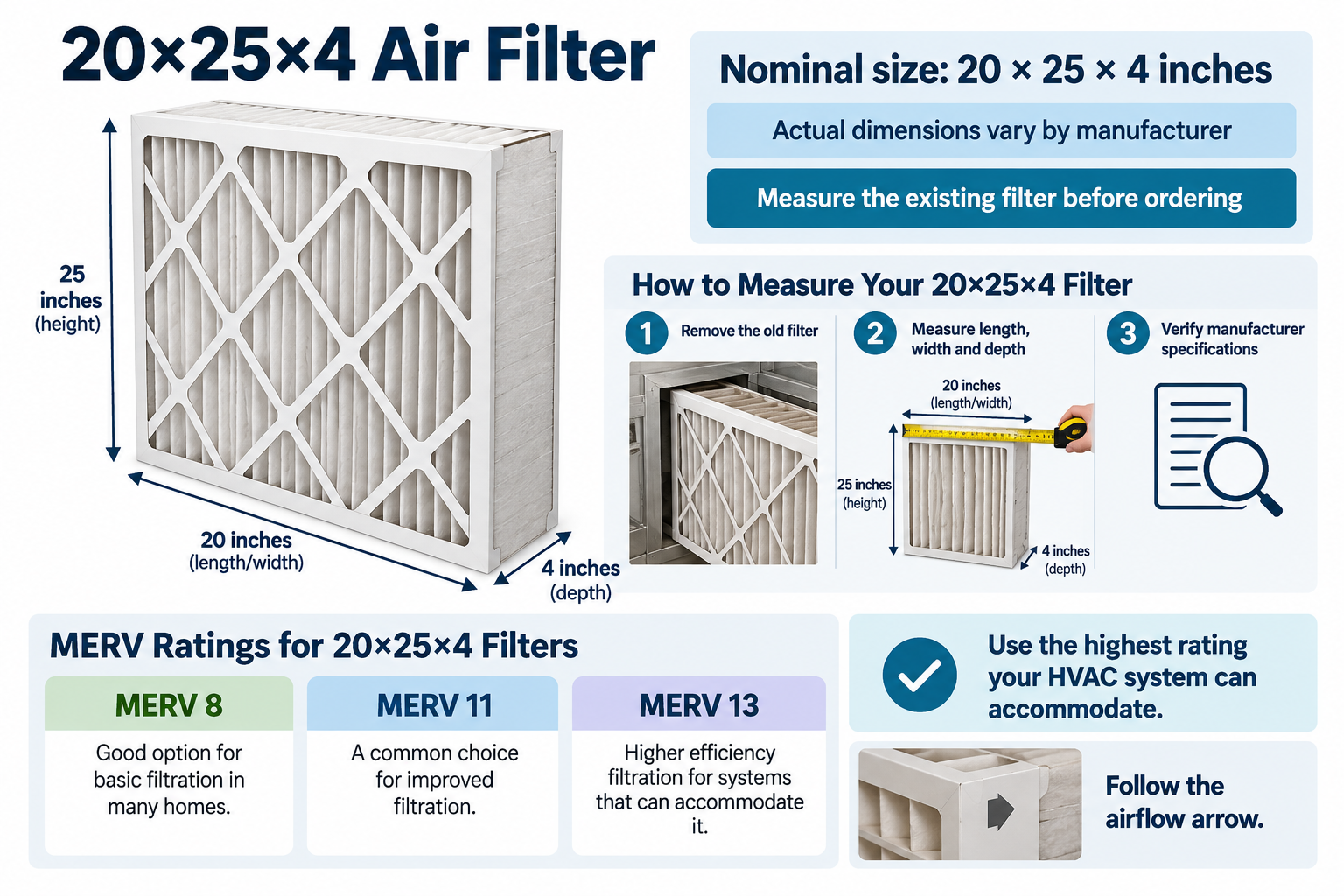
If you need a 20x25x4 air filter, the number on the filter is only the starting point. The 20×25×4 designation is a nominal size, and the actual dimensions can vary significantly between manufacturers.
That matters more with 4-inch filters than it may with thinner 1-inch filters. Some 20×25×4 products are around 3.6 inches deep, while others are around 4.3 inches deep. A filter that looks like the right size on the label may not be the right physical replacement for your filter cabinet. If you’re comparing HVAC filter sizes, see our main Air Filters guide for help with filter dimensions, MERV ratings, replacement schedules, and choosing the right filter.
Before ordering, check the size printed on your existing filter, measure its actual dimensions when possible, and verify that the replacement filter is designed for your HVAC system.
This guide covers 20x25x4 filter dimensions, actual depth, MERV ratings, replacement intervals and current buying options so you can choose a replacement with fewer surprises.
20x25x4 Air Filter at a Glance
| Specification | What to know |
|---|---|
| Nominal size | 20 × 25 × 4 inches |
| Filter type | Usually pleated media |
| Common MERV ratings | MERV 8, 11 and 13 |
| Used in | Furnaces, central AC and heat-pump HVAC systems |
| Actual dimensions | Vary by manufacturer and filter system |
| Actual depth | Can vary substantially among products |
| Replacement interval | Follow the manufacturer’s recommendation and inspect the filter regularly |
| Most important buying check | Match the replacement to your existing filter/cabinet, not just the printed nominal size |
Important: A 20×25×4 filter is not necessarily physically 20 × 25 × 4 inches. Always check the replacement model’s actual dimensions.
What Does 20x25x4 Mean?
The three numbers describe the filter’s nominal width, height and depth:
- 20 inches — nominal width
- 25 inches — nominal height
- 4 inches — nominal depth
These numbers are primarily used to identify the filter category.
They do not necessarily describe the exact physical dimensions of the filter.
For ordinary replacement shopping, the nominal size is useful because it lets you find the right category quickly. The actual dimensions become important when you’re replacing a filter with a different brand or when the filter fits into a dedicated media cabinet.
20x25x4 Actual Size: Why Depth Matters
The biggest mistake to avoid with a 20×25×4 filter is assuming that every product with that label has the same actual dimensions.
For example, Filterbuy publishes an actual size of 19.5 × 24.5 × 3.63 inches for its standard 20×25×4 filter.
3M’s published Filtrete specifications include a 20×25 filter with an actual size of 19.88 × 24.63 × 4.31 inches.
That’s a difference of roughly 0.68 inch in actual depth.
That is large enough to matter when you’re working with a filter cabinet designed around a particular media depth.
If you need a smaller 1-inch filter, read our 20x20x1 air filter guide covers sizing, MERV ratings, and the best options for that common filter size.
What to check before ordering
Compare:
- Nominal size
- Actual length
- Actual width
- Actual depth
- Filter/cabinet model if applicable
- MERV rating
If you still have the old filter, measure it before ordering a different brand.
20x25x4 Filter Depth: 3.6 Inches vs. 4.3+ Inches
This is one of the most useful things to understand about this filter size.
Some products sold as 20×25×4 have an actual depth around 3.63 inches. Filterbuy publishes this dimension for its standard 20×25×4 products.
Filtrete’s published specifications include a 20×25×4 configuration measuring approximately 4.31 inches deep.
And some proprietary whole-home filter systems use still different dimensions. For example, AprilAire publishes its 210 and 213 replacement filters as nominal 20×25×4 products with actual measurements of 20.6 × 26.63 × 4 inches. Those filters are designed for compatible AprilAire air-purifier cabinets.
The practical lesson
Do not buy a 20×25×4 filter based solely on the three numbers printed in the search result.
If you’re changing brands, compare the actual dimensions and the compatible HVAC/media-cabinet model.
This is especially important for whole-house media systems.
Which MERV Rating Should You Choose?
MERV stands for Minimum Efficiency Reporting Value. It is a standardized way of describing an HVAC filter’s particle-capture performance.
A higher MERV rating generally means greater filtration of smaller particles, but the best choice is the highest rating your HVAC system can properly accommodate.
The EPA recommends selecting MERV 13 or the highest rating your system’s fan and filter slot can accommodate. If you’re unsure, consult the HVAC manufacturer’s documentation or a qualified professional. US EPA
A practical starting point
| MERV | General use | Considerations |
|---|---|---|
| MERV 8 | Basic residential filtration | Often a reasonable starting point when higher filtration isn’t required |
| MERV 11 | More filtration for dust, pollen and other smaller particles | Popular middle-ground choice |
| MERV 13 | Higher-efficiency filtration | Use when the HVAC system can accommodate it |
Don’t choose MERV 13 simply because the number is higher.
Your HVAC system’s requirements come first.
MERV 8 vs. MERV 11 vs. MERV 13
MERV 8
It can be appropriate when your main goal is basic filtration and equipment protection.
It can help capture larger airborne particles such as dust and pollen.
MERV 11
MERV 11 provides a higher level of filtration and is a common choice for homeowners who want more particle capture than a basic MERV 8 filter.
It can be a reasonable choice for households dealing with more dust, pollen or pet-related particles, provided the HVAC system is designed to use it.
MERV 13
MERV 13 provides still higher filtration efficiency for many particle sizes.
EPA recommends MERV 13 or the highest rating the system can accommodate when higher filtration is desired.
If you’re considering moving from MERV 8 or 11 to MERV 13, check your equipment specifications first.
Source: U.S. EPA guidance on HVAC filters and MERV ratings.
Best 20x25x4 Air Filters to Buy
Affiliate disclosure: As an Amazon Associate, Your Own Consumer earns from qualifying purchases.
If you need a 20×25×4 filter, these are three options worth considering. We compared current listings based on MERV rating, actual dimensions, pack size, manufacturer information, compatibility and overall buying value.
These are starting points rather than universal recommendations. The right filter depends on your HVAC system and the actual filter/cabinet dimensions.
Our recommended comparison
| Our pick | Filter | Best for | MERV | Pack | Approx. actual size |
|---|---|---|---|---|---|
| Best Overall | Filtrete 20×25×4 | Widely available replacement option | 11 | 2-pack | 19.88 × 24.63 × 4.31 in |
| Best Shallower 4-Inch Option | Filterbuy 20×25×4 | Lower actual depth and U.S. manufacturing | 8 | 2-pack | 19.50 × 24.50 × 3.63 in |
| Best for Compatible AprilAire Cabinets | AprilAire 210 | Genuine replacement for compatible AprilAire systems | 11 | 2-pack | 20.6 × 26.63 × 4 in |
20x25x4 Furnace Filter vs. AC Filter
A 20×25×4 filter can be used in systems that require that size for heating, cooling or both.
The important distinction isn’t whether the filter is called a “furnace filter” or “AC filter.”
The important questions are:
- Is the size correct?
- Is the actual depth compatible?
- Is the MERV rating appropriate?
- Does the filter fit securely?
- Is the airflow direction correct?
The same filter may be marketed for furnace, central AC, heat pump and HVAC applications.
Don’t buy a filter simply because the listing says “furnace” if your system is using the same filter slot for central AC.
How Often Should You Replace a 20x25x4 Filter?
A 4-inch filter generally has more media area than a 1-inch filter, so replacement intervals can be longer, but there is no universal replacement interval that applies to every home or filter.
Some manufacturers recommend intervals such as three to six months, while specific whole-home systems can have longer manufacturer-recommended schedules. Nordic Pure, for example, recommends changing its 4-inch filters every 3–6 months.
AprilAire recommends annual replacement for its 210 and 213 products under the applicable system conditions.
Use the manufacturer’s schedule as your starting point
Inspect the filter more often if you have:
- pets
- heavy dust
- construction or remodeling
- wildfire smoke
- high household occupancy
- other conditions that load the filter quickly
The safest rule is:
Follow the filter and HVAC manufacturer’s recommendation and inspect the filter regularly. Replace it sooner if it is visibly loaded or your system indicates that it needs replacement.
How to Install a 20x25x4 Air Filter
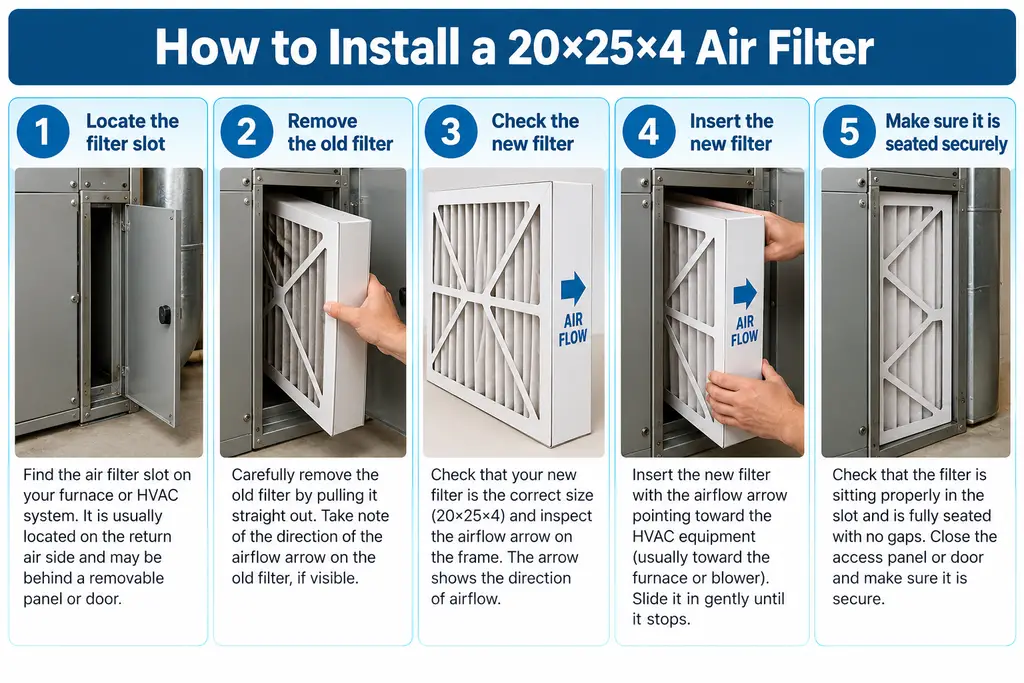
Step 1: Locate the filter
Find the filter slot on your furnace, air handler or return-air system.
The filter may sit behind a removable access panel.
Step 2: Remove the old filter
Pull the old filter out carefully.
If the filter is dirty, note how it was positioned before removing it.
Step 3: Check the new filter
Confirm:
- nominal size
- actual dimensions
- MERV rating
- filter depth
- airflow arrow
Step 4: Follow the airflow arrow
The arrow should point in the direction of airflow toward the HVAC equipment.
Do not simply copy the orientation of the pleats.
Step 5: Seat the filter properly
Slide the filter into the slot without forcing it.
It should sit securely without being crushed or bent.
EPA likewise advises making sure the filter fits snugly so air doesn’t leak around it and not bending or crushing a filter to make it fit.
Step 6: Close the access panel
Make sure the filter and access panel are secure before operating the system.
20x25x4 Air Filter Buying Checklist
Before clicking Buy, check these seven things:
1. Confirm the nominal size
Your existing filter should indicate 20×25×4 or the system documentation should specify that size.
2. Measure the existing filter
If you’re changing brands, measure:
- length
- width
- depth
3. Pay particular attention to depth
This is unusually important with 4-inch filters.
A 3.63-inch actual-depth filter and a 4.31-inch actual-depth filter aren’t necessarily interchangeable in every cabinet.
4. Check the MERV rating
Don’t automatically buy the highest number.
Use the highest rating your HVAC system can accommodate.
5. Check the filter/cabinet model
This is especially important for AprilAire and other dedicated media-air-cleaner systems.
6. Compare pack sizes
Calculate:
Cost per filter = package price ÷ number of filters
A larger pack may reduce the cost per replacement, but only if the filters actually fit your system.
7. Check the airflow arrow
The arrow should point toward the HVAC equipment.
FAQs for 20x25x4 filter
Not necessarily. The printed 20×25×4 measurement is a nominal size. Actual dimensions vary by manufacturer and filter system. Some products are substantially different in actual depth, so check the specific filter’s published dimensions before ordering.
There is no single actual size for every 20×25×4 filter. For example, Filterbuy publishes 19.5 × 24.5 × 3.63 inches for one standard 20×25×4 filter, while 3M publishes 19.88 × 24.63 × 4.31 inches for a Filtrete configuration.
MERV 11 generally provides higher filtration efficiency for many particle sizes than MERV 8, but that doesn’t automatically make it the right choice for every HVAC system. Follow your equipment manufacturer’s recommendations.
Possibly. The physical size alone does not determine whether MERV 13 is appropriate. EPA recommends MERV 13 or the highest rating your system can accommodate, but you should verify compatibility before upgrading.
Follow the manufacturer’s recommendation and inspect the filter regularly. Many 4-inch filters are designed for several months of use, but replacement intervals vary by product and household conditions.
Yes, if your central HVAC system uses a compatible 20×25×4 filter. Confirm the actual dimensions, depth and MERV rating before ordering.
Different manufacturers and HVAC cabinet systems use different construction and sizing conventions. A nominal 20×25×4 label does not guarantee identical actual dimensions.
No. AprilAire replacement filters such as the 210 and 213 are designed for compatible AprilAire systems and models. Verify your cabinet/model before buying. AprilAire
Often, yes, because a deeper filter can contain more filter media, but the actual replacement interval depends on the specific filter, HVAC system and household conditions. Follow the manufacturer’s recommendation rather than assuming a fixed lifespan.
Not automatically. Filter depth is part of the fit. Some products labeled 20×25×4 have actual depths around 4.3 inches, while others are around 3.6 inches. Do not substitute a different nominal depth unless the filter and HVAC manufacturer indicate that it is compatible.
Bottom Line
A 20x25x4 air filter is not simply a 20-inch by 25-inch by 4-inch box.
The nominal size tells you what category to search for. The actual dimensions, especially depth, determine whether a particular replacement is appropriate for your filter cabinet.
Before buying:
- Confirm the 20×25×4 nominal size.
- Measure your existing filter if possible.
- Compare actual dimensions.
- Check the MERV rating.
- Verify compatibility with your HVAC or media cabinet.
- Follow the airflow arrow when installing it.
If you’re upgrading filtration, EPA recommends MERV 13 or the highest rating your HVAC system can accommodate.