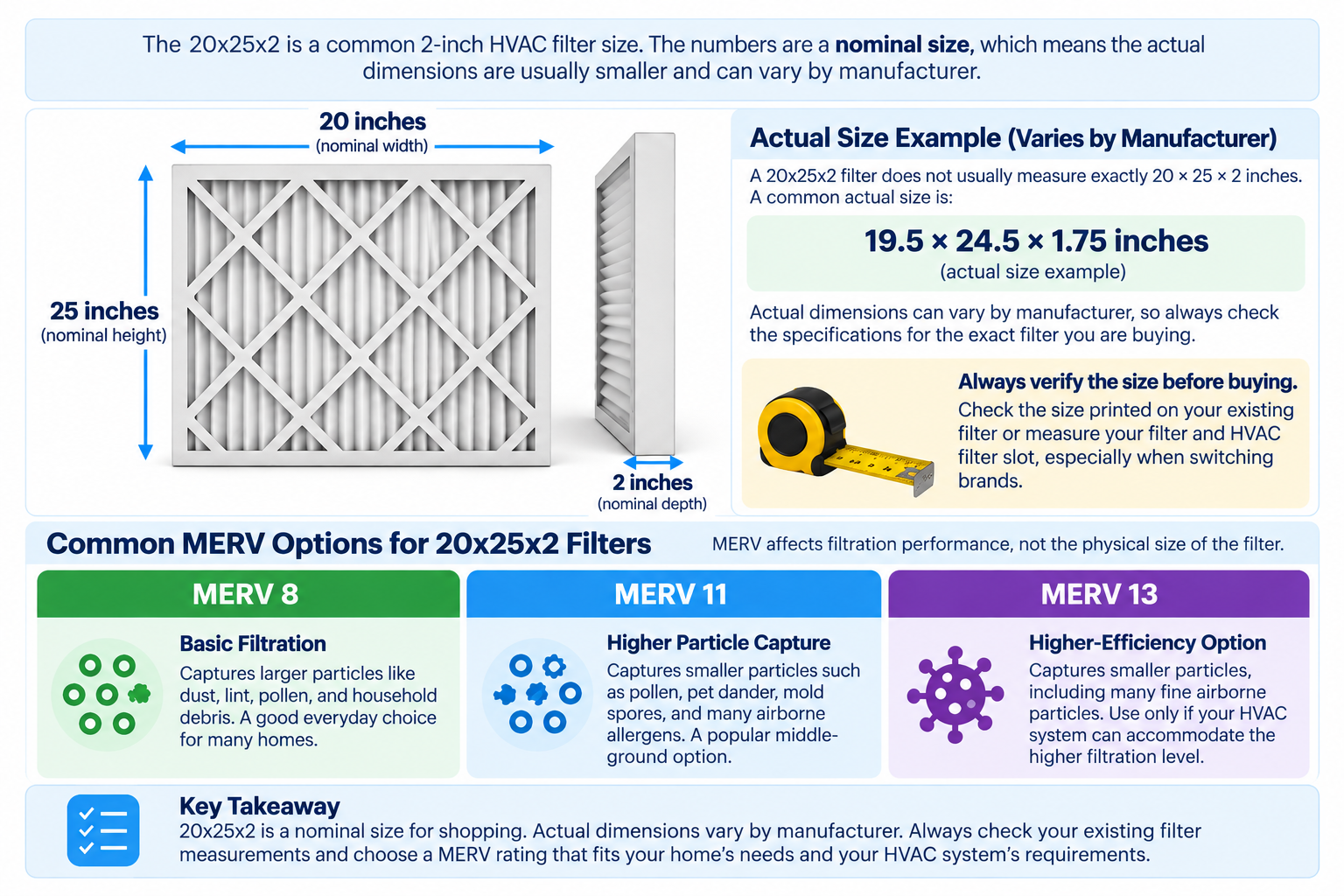
A 20x25x2 air filter is a common residential HVAC filter size used in furnaces, central air conditioners and other forced-air systems. The size printed on the filter is the nominal size; a commonly listed actual size is about 19.5 × 24.5 × 1.75 inches, although actual dimensions can vary by manufacturer.
Before buying a replacement, confirm the size printed on your current filter or measure the existing filter and check your HVAC system’s specifications. Then choose a MERV rating that provides the filtration you want and that your system can accommodate.
If you are comparing other sizes, see our 20x25x1 air filter and 20x25x4 air filter guides.
20x25x2 Air Filter at a Glance
| Feature | Details |
|---|---|
| Nominal size | 20 × 25 × 2 inches |
| Common actual size | About 19.5 × 24.5 × 1.75 inches |
| Filter type | Pleated HVAC filter |
| Common MERV ratings | MERV 8, MERV 11, MERV 13 |
| Typical use | Residential furnace, central AC and heat-pump systems |
| Filter depth | 2-inch nominal |
| Main buying decision | Correct size + appropriate MERV rating |
| Replacement | Follow the filter and HVAC manufacturer’s guidance |
The 20×25×2 size is the ordering size, not necessarily the exact physical measurement of the filter. Filterbuy and other manufacturers currently list 19.5 × 24.5 × 1.75 inches as the actual dimensions for this nominal size.
What Does 20x25x2 Mean?
The numbers describe the filter’s nominal dimensions:
- 20 inches — one face dimension
- 25 inches — the other face dimension
- 2 inches — nominal filter depth
The actual filter is usually somewhat smaller so it can slide into the filter rack without being forced. For example, Filterbuy currently lists its 20×25×2 filters at 19.5 × 24.5 × 1.75 inches.
The safest approach is to check the existing filter before ordering.
If the label on your current filter says 20×25×2, that is normally the size you should shop for.
20x25x2 Actual Size: Nominal vs. Measured
A common actual measurement for a 20×25×2 filter is:
| Dimension | Nominal | Common actual |
|---|---|---|
| Width | 20 in | 19.5 in |
| Height | 25 in | 24.5 in |
| Depth | 2 in | 1.75 in |
Actual dimensions can vary between manufacturers, so don’t assume that every filter sold under the same nominal size will measure exactly the same.
Before ordering
If you have the old filter:
- Remove it from the HVAC system.
- Look for the size printed on the filter frame.
- Measure width, height and depth if necessary.
- Compare those measurements with the replacement manufacturer’s specifications.
- Make sure the new filter fits without bending, crushing or forcing it.
EPA guidance also emphasizes that HVAC filters should fit snugly and should not have to be bent or crushed to fit. US EPA
20x25x2 vs. Other Filter Sizes
The depth matters just as much as the face dimensions.
| Filter | Common actual depth | Difference |
|---|---|---|
| 20x25x1 | About 0.75 in | Thinner |
| 20x25x2 | About 1.75 in | This page |
| 20x25x4 | About 3.5–3.75 in, depending on product | Much deeper |
A 20×25×1 filter should not automatically be substituted for a 20×25×2 filter. Your filter rack or cabinet determines which depth is designed to fit.
For the thinner version, see our 20x25x1 air filter guide.
For the deeper media-filter version, see our 20x25x4 air filter guide.
MERV Ratings for 20x25x2 Air Filters
MERV stands for Minimum Efficiency Reporting Value. It is a standardized way to compare an HVAC filter’s ability to capture particles in different size ranges.
EPA’s current MERV guidance shows that higher MERV ratings generally capture a greater percentage of smaller particles. US EPA
For this page, the practical choices to compare are MERV 8, MERV 11 and MERV 13.
| MERV | What it means | Good starting point for |
|---|---|---|
| MERV 8 | Basic-to-moderate particle filtration | General household filtration |
| MERV 11 | Higher filtration of smaller particles | Homes with pets, pollen or greater filtration needs |
| MERV 13 | High-efficiency filtration | Smoke, fine particles and households seeking higher filtration, if HVAC system supports it |
Which MERV Rating Should You Buy?
Use this as a practical starting point:
| If your priority is… | Consider |
|---|---|
| Basic everyday filtration | MERV 8 |
| More filtration for pets/pollen | MERV 11 |
| Higher filtration for fine particles/smoke | MERV 13, if compatible |
| You’re unsure what your system allows | Follow HVAC manufacturer guidance |
The important point is that MERV does not change the physical size of the filter.
A 20×25×2 MERV 8 and a 20×25×2 MERV 13 are both intended for the same nominal filter size. The filtration characteristics are different.
Best 20x25x2 Air Filters to Consider
Don’t present these as products we personally tested. Instead, position them as current options worth comparing based on published specifications.
| Product | MERV options | Actual size | Why consider it |
|---|---|---|---|
| Filterbuy 20x25x2 | 8 | 19.5 × 24.5 × 1.75 in | Broad MERV range and multiple pack sizes |
| Aerostar 20x25x2 | 13 | 19.5 × 24.5 × 1.75 in | Multiple MERV choices and pack sizes |
| Filtrete 20×25×2 | 11 | 19.5 × 24.5 × 1.75 in | Multiple MERV choices and pack quantities |
Affiliate disclosure: As an Amazon Associate, Your Own Consumer earns from qualifying purchases.
Filterbuy currently lists this size in MERV 8, 11 and 13, with the 19.5 × 24.5 × 1.75-inch actual size. Factory Direct Filters similarly lists its Aerostar 20×25×2 at 19.5 × 24.5 × 1.75 inches and offers MERV 8, 11 and 13 options.
FilterHome currently lists the same nominal size and actual dimensions with MERV 8, 11 and 13 options.
20x25x2 Air Filter for Furnace vs. AC
A 20×25×2 filter can serve as the filter for a central HVAC system that provides both heating and cooling, provided that 20×25×2 is the size specified for the system.
The filter is generally installed in the return-air path before air reaches the HVAC equipment.
You don’t normally buy a separate “furnace filter” and “AC filter” simply because the system has both heating and cooling. The same filter can serve the shared return-air system when the equipment is designed that way.
Always follow your HVAC manufacturer’s instructions if your system has more than one filter location.
How Often Should You Replace a 20x25x2 Air Filter?
There isn’t one universal replacement interval.
Filter life depends on:
- HVAC runtime
- household occupancy
- pets
- dust levels
- outdoor air quality
- filter efficiency
- filter loading
A 90-day interval is a reasonable starting point for many pleated residential filters, but the filter should be inspected rather than treated as a guaranteed lifespan. Current Filterbuy guidance for this size recommends replacement around every 90 days and more frequent changes for some households.
Check the filter sooner if:
- The pleats are visibly loaded with dust.
- Airflow seems reduced.
- You have pets.
- You are experiencing unusually heavy HVAC use.
- Outdoor smoke or particulate levels are high.
Follow the manufacturer’s replacement guidance where it differs.
How to Check if a 20x25x2 Air Filter Fits
Before ordering:
1. Check the old filter
Look along the cardboard frame for a printed size such as:
20 × 25 × 2
2. Measure it
Measure:
- width
- height
- depth
Remember that actual dimensions can be smaller than the nominal size.
3. Check the HVAC documentation
If you’re changing MERV rating, check whether your HVAC system supports the rating you want.
4. Check the fit
The filter should sit securely in its intended slot.
It should not need to be bent, crushed or forced into position.
How to Install a 20x25x2 Air Filter
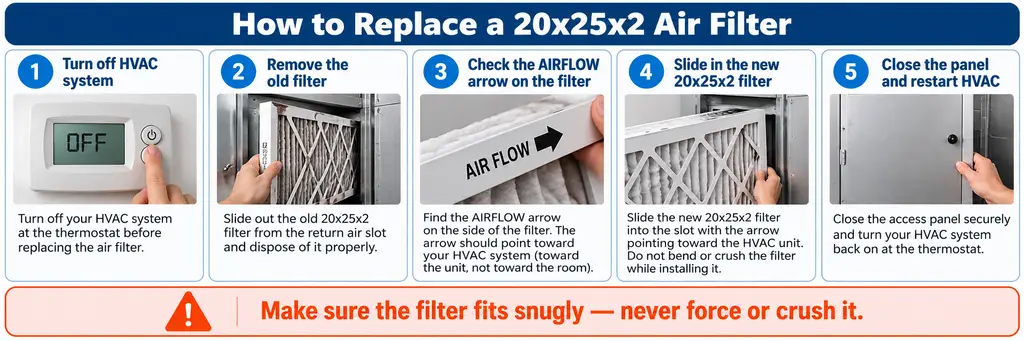
- Turn off the HVAC system before removing the filter.
- Open the return grille or filter cabinet.
- Remove the old filter.
- Look for the airflow arrow on the new filter.
- Install the filter with the arrow pointing in the direction of airflow, toward the HVAC equipment.
- Make sure the filter is seated properly.
- Close the access panel or grille.
- Restart the HVAC system.
Important
Do not force a filter into a slot that is too small.
If the filter doesn’t fit correctly, stop and verify the nominal size, actual dimensions and filter depth.
20x25x2 Air Filter FAQs
Usually not. The 20×25×2 designation is a nominal size. A common actual measurement is about 19.5 × 24.5 × 1.75 inches, but actual dimensions vary by manufacturer.
No. They have the same nominal face dimensions but different depths. A 20×25×2 filter is intended for a deeper filter slot than a 20×25×1 filter.
See our [20x25x1 air filter guide](/air-filters/20x25x1/) for the thinner version.
Yes, MERV 13 filters are available in the 20×25×2 size. However, your HVAC system must be able to accommodate the filter’s airflow resistance. EPA recommends MERV 13 or the highest rating the system can accommodate when upgrading filtration.
MERV 11 provides higher filtration performance for smaller particles than MERV 8. Whether it is the better choice for your home depends on your filtration needs and HVAC system.
Many manufacturers recommend roughly 90 days for a standard residential application, but actual replacement frequency depends on system use and household conditions. Inspect the filter regularly and follow the manufacturer’s guidance.
If your central HVAC system uses the same return-air filter location for heating and cooling, the same correctly sized filter serves both functions.
It is commonly installed in the return-air path, either behind a return grille or inside a filter cabinet near the HVAC equipment. The exact location depends on the system.
Don’t force it. Remove the filter and verify the nominal size, actual dimensions and depth. A filter that doesn’t fit correctly may allow air to bypass the filter or prevent proper airflow.
Bottom Line
If your HVAC system calls for a 20x25x2 air filter, confirm the size before ordering and remember that the nominal 20×25×2 dimensions are usually larger than the physical filter.
A common actual size is about 19.5 × 24.5 × 1.75 inches, but check the manufacturer’s specifications for the exact filter you buy.
For MERV selection, MERV 8 is a practical starting point for basic filtration, MERV 11 provides more filtration for households with greater particle concerns, and MERV 13 offers higher-efficiency filtration when the HVAC system can accommodate it. EPA recommends MERV 13 or the highest rating the system can accommodate when upgrading filtration.