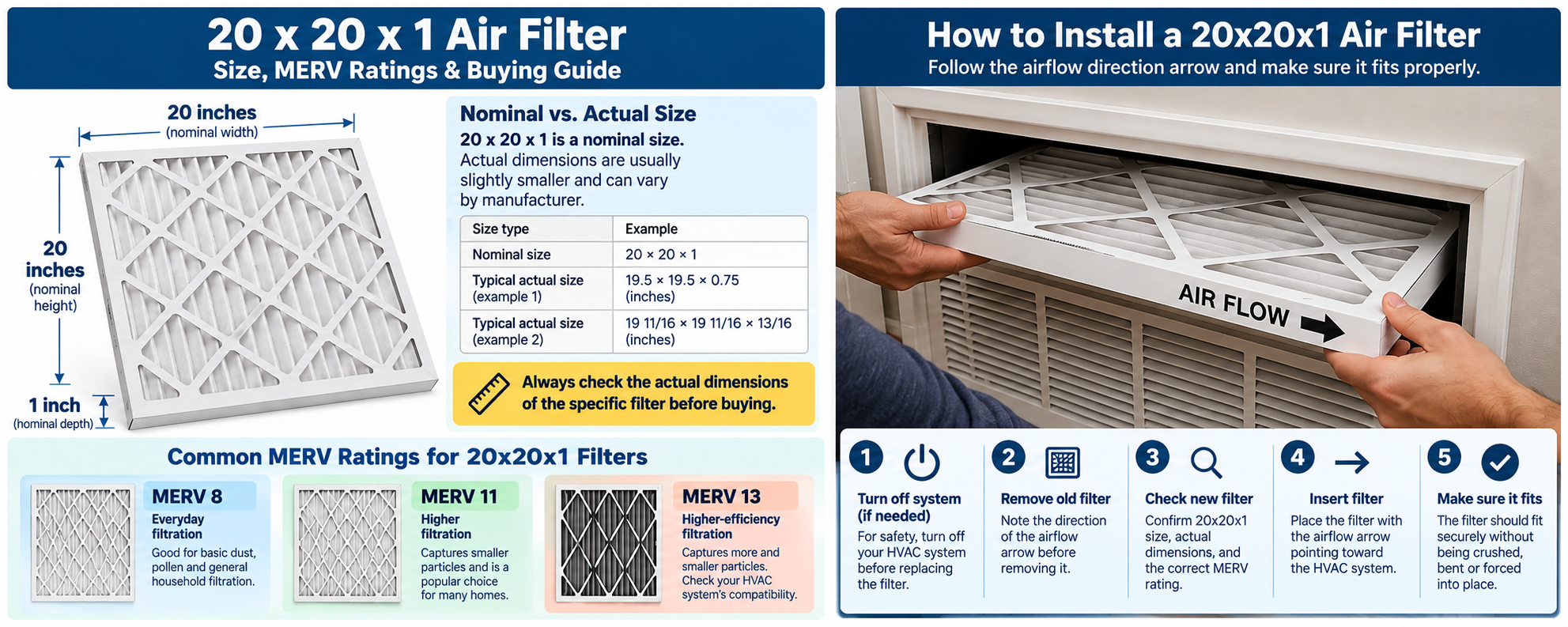
If you need a 20x20x1 air filter, you’re looking for a common 1-inch HVAC filter size used in residential heating and cooling systems.
The important part is making sure you get three things right:
- The filter fits your HVAC system.
- The actual dimensions match what your filter slot requires.
- The MERV rating is appropriate for your system.
A 20x20x1 filter is a nominal size, so the filter you receive will normally be somewhat smaller than 20 × 20 × 1 inches. Actual dimensions vary by manufacturer and model, so check the product specifications before ordering.
20x20x1 Air Filter at a Glance
| Feature | What to know |
|---|---|
| Nominal size | 20 × 20 × 1 inches |
| Filter depth | Designed for a 1-inch filter slot |
| Common uses | Furnace, central AC, heat pump and other forced-air HVAC systems |
| Common MERV ratings | MERV 8, MERV 11 and MERV 13 |
| Typical replacement interval | Check monthly and replace according to condition and manufacturer guidance |
| Most important buying check | Confirm both nominal and actual dimensions |
| Best starting point | Match your current filter unless your HVAC manufacturer recommends a different rating |
Before you buy: Look at the size printed on your existing filter and check its actual dimensions. If the new filter’s actual size differs significantly from your current filter, don’t assume it will fit simply because the box says 20x20x1.
Best 20x20x1 Air Filters to Buy
If you need a 20x20x1 filter, these are three options worth considering. We compared current 20x20x1 listings based on MERV rating, actual dimensions, pack size, manufacturer information, and overall buying value. These are useful starting options, but the right filter for your home depends on your HVAC system’s requirements.
Always confirm that the filter’s actual dimensions and MERV rating are appropriate for your HVAC system before ordering.
| Our pick | Filter | Best for | MERV | Pack | Approx. actual size |
|---|---|---|---|---|---|
| Best Overall | Filtrete 20×20×1 | Established brand and convenient multi-pack | 11 | 4-pack | 19.68 × 19.68 × 0.81 in |
| Best Value | Amazon Basics 20×20×1 | Buying six filters at once | 11 | 6-pack | 19.75 × 19.75 × 0.75 in |
| Best Made-in-USA Option | Filterbuy 20×20×1 | U.S. manufacturing and bulk replacement | 11 | 4-pack | 19.50 × 19.50 × 0.75 in |
Important: MERV 11 is not automatically the right choice for every HVAC system. Check your equipment manufacturer’s recommendations before upgrading from your current filter rating.
Affiliate disclosure: As an Amazon Associate, Your Own Consumer earns from qualifying purchases.
What Does 20x20x1 Mean?
The three numbers describe the filter’s nominal length, width and thickness.
So:
20 × 20 × 1 = 20 inches × 20 inches × 1 inch nominal size.
The word nominal matters because HVAC filter sizes are commonly rounded for easier identification and ordering.
The actual physical filter can be smaller than the nominal dimensions. For example, one current Nordic Pure 20x20x1 filter is listed at 19.5 × 19.5 × 0.75 inches, while 3M lists a 20x20x1 MERV 8 filter at 19 11/16 × 19 11/16 × 13/16 inches.
In other words, don’t assume that every manufacturer’s 20x20x1 filter measures exactly the same.
Nominal vs. actual size
| Size type | Example |
|---|---|
| Nominal size | 20 × 20 × 1 |
| Actual size | Depends on the manufacturer and filter model |
| What you search for | The nominal size |
| What you should verify before buying | The actual dimensions |
If you still have the old filter, measure it and compare those measurements with the replacement filter’s specifications.
What Is the Actual Size of a 20x20x1 Air Filter?
There isn’t one universal actual dimension for every product labeled 20x20x1.
Many products are around 19.5 × 19.5 × 0.75 inches, but other manufacturers use slightly different dimensions.
For example:
- Nordic Pure lists a 20x20x1 product at 19.5 × 19.5 × 0.75 inches.
- 3M’s technical data for one 20x20x1 MERV 8 filter lists 19 11/16 × 19 11/16 × 13/16 inches.
- Other manufacturers may list measurements such as approximately 19.6 × 19.6 × 0.8 inches.
This is why the safest approach is to check the actual-size specification for the exact filter you plan to buy.
How to check your size
- Turn off the HVAC system if necessary to safely access the filter.
- Remove the existing filter.
- Look for the printed nominal and actual dimensions.
- If the dimensions aren’t printed, measure the filter.
- Compare your measurements with the replacement filter’s listed actual dimensions.
- Check the filter depth carefully. A 1-inch filter is not interchangeable with a 2-inch or 4-inch filter simply because the face dimensions are the same.
If you are unsure, check the HVAC manufacturer’s documentation or have an HVAC professional verify the filter size.
Which MERV Rating Should You Choose for a 20x20x1 Filter?
The size of the filter doesn’t determine its MERV rating.
You can find 20x20x1 filters in several MERV ratings, including MERV 8, MERV 11 and MERV 13.
MERV stands for Minimum Efficiency Reporting Value. A higher MERV rating generally means the filter is more efficient at capturing particles in the size ranges covered by the rating system.
The U.S. EPA recommends choosing the highest-rated filter that your HVAC system and filter slot can accommodate, with MERV 13 or higher as a target when the system can handle it.
However, you shouldn’t automatically install the highest-MERV filter you can find. Check your HVAC manufacturer’s recommendations first.
MERV 8 vs. MERV 11 vs. MERV 13
| MERV | Good starting point for | Considerations |
|---|---|---|
| MERV 8 | Basic dust, pollen and general household filtration | Often a practical lower-resistance option |
| MERV 11 | Households wanting more filtration than MERV 8 | A useful middle ground for many systems |
| MERV 13 | Higher-efficiency particle filtration | Verify that your HVAC system can accommodate it |
MERV ratings are based on standardized testing, and higher isn’t automatically better if the HVAC system cannot handle the filter’s airflow resistance.
The EPA specifically recommends MERV 13, or the highest efficiency your system can accommodate. (Source: U.S. EPA guidance on HVAC filters and MERV ratings)
If you’re upgrading from a lower MERV filter, check your furnace or HVAC manufacturer’s specifications before making the change.
Is MERV 13 Better for a 20x20x1 Filter?
MERV 13 provides higher particle-capture performance than MERV 8 or MERV 11 in the relevant test ranges.
But MERV 13 isn’t automatically the right choice for every HVAC system.
Higher-efficiency filtration can increase resistance to airflow. The EPA recommends using MERV 13 or the highest rating the system can accommodate.
If your system documentation specifies a maximum filter rating, follow that recommendation.
For a new filter purchase, the safest decision is usually:
Match the existing MERV rating unless you have a reason and confirmation to change it.
20x20x1 Furnace Filter vs. AC Filter
You may see products described as:
- 20x20x1 furnace filter
- 20x20x1 AC filter
- 20x20x1 HVAC filter
- 20x20x1 air filter
These names can describe the same basic filter size.
A forced-air HVAC system may use the filter during both heating and cooling. What matters most is whether the filter has the correct dimensions, depth and performance characteristics for your system.
Don’t buy a filter just because it says “furnace filter” or “AC filter.” Confirm that the size and MERV rating are appropriate for your equipment.
How Often Should You Change a 20x20x1 Air Filter?
There is no single replacement interval that is right for every home.
A commonly recommended starting point for a 1-inch filter is to check it about every 30 days and replace it when it becomes dirty or according to the manufacturer’s recommended interval.
Some manufacturers recommend replacement intervals of roughly 30 to 90 days for 1-inch filters, depending on conditions.
You may need to replace the filter more frequently if you have:
- Pets
- Heavy household traffic
- Construction or renovation dust
- High heating or cooling usage
- Significant outdoor pollution
- Smoky conditions
- A household member with particular air-quality concerns
Don’t wait for the calendar if the filter is visibly loaded with dust.
A simple replacement routine
Install → check after 30 days → inspect regularly → replace when needed.
Once you learn how quickly your particular filter becomes dirty, you can establish a more useful replacement schedule.
How to Install a 20x20x1 Air Filter
Replacing a 1-inch HVAC filter is usually straightforward.
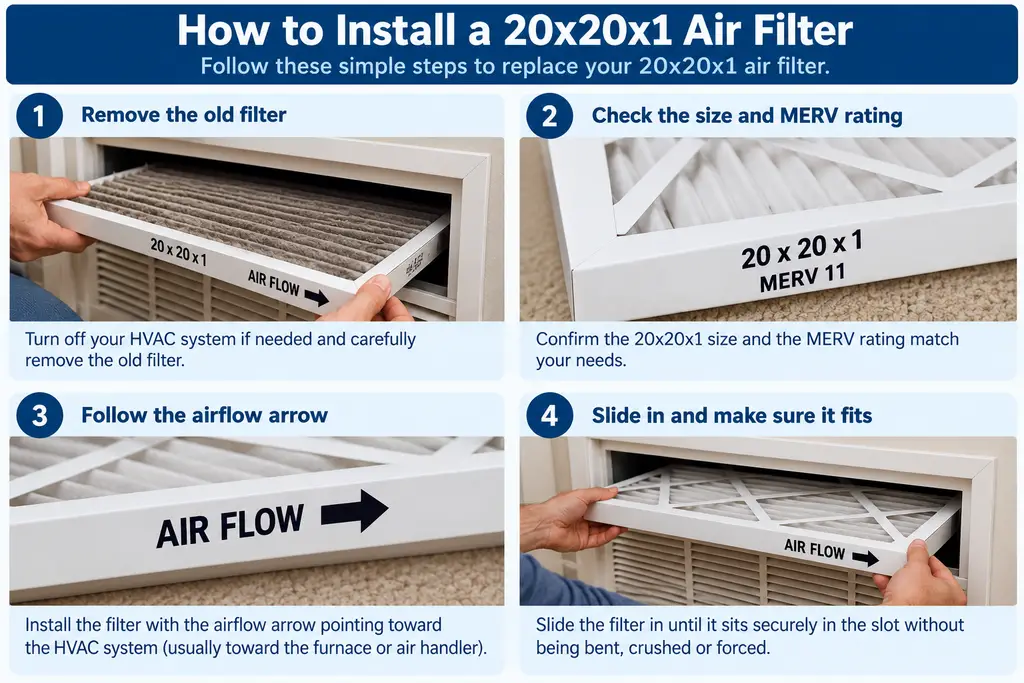
1. Find the filter
The filter may be located in a return-air grille, furnace cabinet, air handler or another designated filter compartment.
2. Remove the old filter
Note which direction the airflow arrow points before removing it.
3. Check the new filter
Confirm:
- 20x20x1 nominal size
- Correct actual dimensions
- Correct MERV rating
- No damage to the frame or media
4. Insert the filter
Follow the airflow direction marked on the filter. The arrow should point in the direction of airflow toward the HVAC equipment.
5. Make sure it sits properly
The filter should fit securely without being crushed, bent or forced into place.
A poor fit can allow air to bypass the filter.
Should You Buy a 20x20x1 Air Filter 12-Pack?
A 12-pack can make sense if you already know the filter fits your system and you expect to use the same filter for the foreseeable future.
For example, if you replace a 1-inch filter approximately every 60 days, a 12-pack could represent about two years of filters.
But don’t buy a large quantity before confirming the fit.
Best practice:
Buy a smaller pack first if you’re testing a new brand or MERV rating. Once you’ve confirmed that it fits correctly and performs well in your system, buying a larger pack can reduce the cost per filter.
When comparing multi-packs, calculate:
Price per filter = total package price ÷ number of filters
That is more useful than comparing package prices alone.
20x20x1 Air Filter Buying Checklist
Before placing an order, check these seven things:
- Nominal size is 20x20x1
- Actual dimensions match your existing filter
- Filter depth is appropriate for your slot
- MERV rating is suitable for your HVAC system
- Airflow direction is clearly marked
- Pack size makes sense for your replacement schedule
- Price per filter is competitive
If all seven check out, you’re much less likely to end up with the wrong replacement filter.
20x20x1 Air Filter FAQs
Yes. They’re two ways of writing the same nominal filter size.
Actual dimensions vary by manufacturer and model. Many are around 19.5 × 19.5 × 0.75 inches, but you should check the exact product specification before ordering.
MERV 11 generally provides higher filtration efficiency than MERV 8. Whether it is the better choice for your system depends on your HVAC manufacturer’s specifications and airflow requirements.
Not necessarily. MERV 13 filters are available in the 20x20x1 size. However, check that your HVAC system can accommodate that level of filtration before upgrading.
If your furnace or HVAC system is designed for a 20x20x1 filter, yes. Confirm the size and MERV requirements in your equipment documentation.
Yes. If your central AC system is designed for a 20x20x1 filter, you can use a filter of that size. Check the actual dimensions, filter depth, and MERV rating recommended for your HVAC system before ordering.
Check a 1-inch filter about monthly and replace it when it is dirty or according to the manufacturer’s recommendation. Many manufacturers suggest intervals in the range of 30 to 90 days depending on conditions.
No. The printed 20x20x1 size is nominal. Actual filter dimensions are normally smaller and can vary by manufacturer.
Yes, reusable/washable products are available, but verify that the product is designed for your HVAC system and that its dimensions and performance are appropriate.
The arrow should point in the direction the air is moving through the system, generally toward the furnace, air handler or blower.
Bottom Line
A 20x20x1 air filter is a common HVAC filter size, but the numbers printed on the package are not enough to guarantee a good fit.
Before buying, verify the actual dimensions, confirm the 1-inch depth, and choose a MERV rating your HVAC system can handle.
For everyday filtration, MERV 8 and MERV 11 are common choices. If your equipment supports it, MERV 13 provides higher-efficiency particle filtration.
And if you find a filter that fits well and works for your system, buying a multi-pack can make replacement easier and reduce your cost per filter.
Need another filter size? Visit our Air Filters guide or use the Filter Finder when available.